A cricket ball is more than just leather and cork. The way a bowler holds the ball, their grip, dictates its trajectory, seam movement, and eventual delivery to the batsman. Mastering different grips is a crucial step towards becoming a versatile and impactful bowler. This guide will walk you through some of the most common and effective cricket ball grips, explaining their purpose and when to use them.
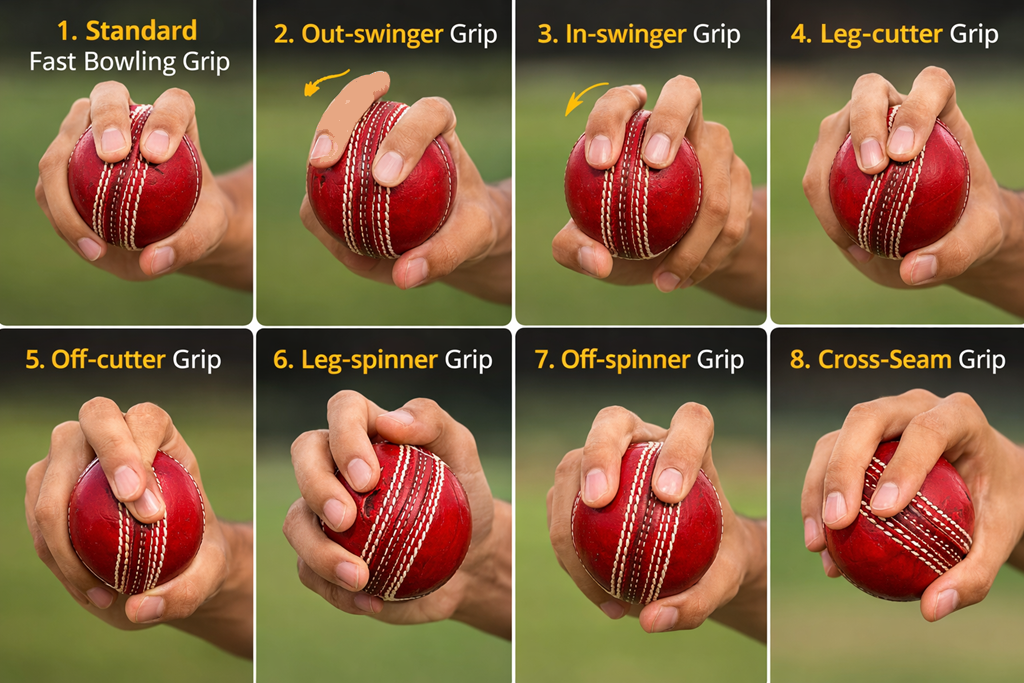
1. The Standard Fast Bowling Grip:
This grip is the foundation for almost all fast bowlers.
- How to hold it: Place your index finger and middle finger parallel on either side of the vertical seam. Your thumb should rest underneath the ball, positioned directly opposite the two fingers. The other fingers should curve naturally around the ball for support.
- Purpose: This grip allows for maximum control and pace. The fingers help release the ball cleanly, ensuring accuracy and seam position.
2. The Out-swinger Grip:
This grip aims to make the ball move away from a right-handed batsman (or into a left-handed batsman).
- How to hold it: Hold the ball similarly to the standard grip, but with a slight adjustment. Angle your index finger slightly outwards (towards the right side for a right-arm bowler). This action puts a tiny bit of “off” spin on the ball as it’s released, encouraging it to swing.
- Purpose: To outfox the batsman by causing late movement after the ball has pitched.
3. The In-swinger Grip:
This grip is designed to make the ball move into a right-handed batsman (or away from a left-handed batsman).
- How to hold it: Again, start with the standard grip but angle your middle finger slightly inwards (towards the left side for a right-arm bowler). This subtle shift imparts a different type of spin, leading to in-swing.
- Purpose: To catch the batsman off guard and challenge their defense.
4. The Leg-cutter Grip:
A classic variation used to create seam movement off the pitch, specifically away from a right-handed batsman.
- How to hold it: This involves a significant change. Place your index and middle fingers close together and cross them slightly over the seam. This grip encourages the ball to cut, or change direction sharply, upon pitching.
- Purpose: To surprise the batsman with unexpected movement, making it difficult to middle the ball.
5. The Off-cutter Grip:
Similar in principle to the leg-cutter, but moves the ball in the opposite direction (into a right-handed batsman).
- How to hold it: Cross your middle and index fingers, but with the middle finger in front of the index finger. This slight change creates a different type of spin, resulting in off-cutter movement.
- Purpose: To create seam movement off the pitch and disrupt the batsman’s timing.
6. The Leg-spinner (or wrist-spinner) Grip:
This is the quintessential leg-spin grip.
- How to hold it: The key is the wrist and finger action. Hold the ball deep in the palm, with the index and middle fingers wrapped around the seam. The little finger and ring finger are tucked underneath, while the thumb rests on top of the seam. The release involves a complex flick of the wrist.
- Purpose: To generate immense leg-spin, causing the ball to turn sharply away from a right-handed batsman.
7. The Off-spinner (or finger-spinner) Grip:
A more direct way of generating spin using the fingers.
- How to hold it: The ball is held using primarily the index and middle fingers, which are spread along the seam. The thumb is placed underneath, opposite the fingers. The spin is generated by rolling the ball off the index finger upon release.
- Purpose: To create consistent off-spin, bringing the ball back into a right-handed batsman.
8. The Cross-Seam Grip:
This grip is used sparingly but can be highly effective.
- How to hold it: Place your fingers across the seam rather than parallel to it. The thumb can be placed either on or off the seam.
- Purpose: This grip can create erratic and unpredictable movement, both through the air and off the pitch. It’s often used on deteriorating pitches or when other grips aren’t producing the desired results.
Important Considerations:
- Practice is Key: Mastering these grips takes time and consistent practice. Start with the basics and gradually introduce variations.
- Experimentation: Don’t be afraid to experiment. Subtle changes in finger pressure, position, and wrist action can yield significant results.
- Body Alignment: Remember that the grip is only part of the equation. Your entire body mechanics, run-up, and release point all play a role in the outcome of the delivery.
- Pitch Conditions: The type of pitch you’re playing on will influence which grips are most effective.
Conclusion:
Understanding and implementing different cricket ball grips can elevate your bowling to a whole new level. By having a range of variations at your disposal, you can become a more versatile bowler and pose a greater challenge to batsmen. So, get out there, practice, and explore the fascinating world of cricket ball grips!
0 Comments